Recruiting differently: what if candidates came to you?



 15 min read
Employer branding isn't a logo on a career page or a well-crafted tagline. It's what your candidates live, feel, and say about you. What if the key to attracting the right profiles was simply being yourself?
Employer branding is, above all, the candidate experience
For Alexandre Noto, co-founder of Intuition Software and Head of Innovation at JobAffinity, a persistent confusion lingers in the minds of many recruiters: mixing up employer branding with brand awareness. As one SME manager summed it up: "I don't have employer branding — I'm not Carrefour." Yet brand awareness is simply being known. Employer branding is something else entirely: it's what a candidate will feel when they first come into contact with you.
It starts with the very first interaction: your job ad, your website, the type of response you give, or the absence of one. Even a small company has an employer brand, whether it wants one or not.
And you don't "create" an employer brand. It's a reflection of what already exists within the company. You can work on it, adjust levers, improve your employer promise, but it remains a mirror of reality, not a marketing construct built from scratch.
This is where authenticity comes in. Employer branding is not an end in itself: it's a means. The goal is for the candidate who best matches your values to apply to you. And the only way for that candidate to know whether what they see matches what they'll experience once in the role is for your communication to be authentic.
"Your employer brand is a means, not an end. The goal is for the candidate who best fits you to apply. And for that, you need to be authentic." — Alexandre Noto
The numbers, from LinkedIn Talent 2025 and Crunchbase Employer 2025, speak for themselves:
- 80% of candidates are sensitive to employer branding.
- 75% of candidates visit the company's website before applying.
- 50% of candidates would refuse to work for a company with a bad reputation, even for better pay.
- Only 35% of French recruiters believe their employer brand is authentic.
The gap between what companies think they project and what candidates actually perceive is considerable. Compare two career sites from companies of similar size: on one side, OnePoint, whose career page displays generic phrases like "Join a dynamic and innovative community of intrapreneurs" or "Tech needs human insight to draw new perspectives for the future": statements that tell the candidate nothing concrete. On the other, Swile, which immediately displays its Glassdoor rating (4.7/5), its gender equality index (84%), a comprehensive health insurance with Alan, the option to bring your dog, a flexible remote work policy, appealing offices, and employee testimonials across different roles.
The difference is glaring. The first company declares its values. The second demonstrates them. That's the whole nuance: a self-confident person at a meeting doesn't say "I'm self-confident." It's their attitude and posture that show it. The same applies to your employer brand.
The candidate is a customer: applying best practices from customer relations
One of Alexandre Noto's key ideas is that candidates should be treated like customers. This isn't just a metaphor: it means transposing 30 years of customer relationship best practices into the world of recruitment.
Take the restaurant analogy. You're walking around one evening and pass by a window: dimmed lighting, modern bar. You're offered a seat at the bar while you wait — you're thrilled. Then they lead you to your table, and you walk into a room that looks like a canteen with fluorescent lighting. The experience just broke in half. That's exactly what happens when a company invests in its employer brand, but when the candidate goes to apply, they land on an impersonal ATS form that destroys everything built up to that point.
The Mistral AI example is telling. The company did excellent employer branding work: authentic visuals featuring real employees, a no-bullshit DNA, concrete benefits (health insurance, restaurant, gym). But at the moment of applying, the candidate lands on a form from an American ATS, without GDPR compliance. The entire experience is broken.
The challenge is consistency throughout the entire experience chain. Web agency Paradisiak, a JobAffinity partner, created two distinct career sites for Yves Rocher: one for franchisees (focused on figures, management, and growth prospects), another for employees (focused on roles, video testimonials, and job ads). Different personas, different messages.
Another example: the work done for Saint-Michel. The brand has a strong identity, and the career site reflects it down to the smallest detail. The "apply" button is a bitten biscuit, and the application form welcomes the candidate with "don't worry, we won't eat you." A friendlier, more modern form that extends the brand experience rather than breaking it.
Candidate experience by the numbers: a worrying picture
The IFOP barometer conducted for YAGGO, a reference survey that directly questions candidates about their experiences, delivers stark results:
- 80% of candidates have already had a bad recruitment experience.
- 53% of candidates cite dehumanization and automation as the main deterrent to applying.
- 54% of higher-income candidates share their bad recruitment experiences on social media.
The dehumanization figure is a major shift. In 2022, this deterrent didn't even appear in surveys. The main barrier back then was being asked to record a video. Today, the feeling of talking to a machine tops the list.
A 2023 study by Intuition Software asked candidates to rank their preferred type of response after applying. The surprising result: the phrase "if you haven't heard from us in a few days, consider it a no" ranked last, worse even than receiving no response at all. Why? Because getting no response can be explained by a temporary overload. But that phrase signals that poor quality has become a deliberate process, not an exception.
And the consequences aren't just reputational: they're business consequences too. The IFOP barometer reveals a figure every CEO should know:
29% of candidates reduce or stop purchasing from a company after a bad recruitment experience.
In other words, between a quarter and a third of poorly treated candidates become lost customers. That's a powerful argument for HR teams seeking budget to work on their employer brand: candidate experience has a direct impact on revenue.
Responding to all candidates: a matter of tools and organisation
One key point: the response channel must match the stage in the process. For an application received, an email is enough. For a candidate interviewed twice, a phone call is essential. The analogy is striking: you don't break up with someone after 3 years by text message. Equally, you don't turn down a candidate after several interviews with a simple automated email.
The recurring question remains: how do you respond to all candidates when you receive hundreds? According to Alexandre Noto, this argument no longer holds. He cites his own experience as a recruiter at Pages Jaunes, where he received around 600 applications for a mobile sales role, including roughly a hundred candidates without a driving licence. His method: a pre-qualification questionnaire with two or three simple questions, including "Do you have a driving licence?". Those who answered no received an automatic negative score.
Then, in JobAffinity, a simple filter on the score isolates those candidates. One click on "select all," then "contact by email" with a pre-written template: "Thank you for your application. This role is field-based and requires a driving licence. We won't be able to move forward with you on this opportunity. However, please feel free to apply for our office-based sales role at the following link." In a matter of seconds, 100 candidates receive a rejection that says no, explains why, and offers an alternative. The perceived quality for the candidate is huge; the effort for the recruiter is minimal.
Another practical case: a client attending a recruitment fair and facing a queue at their stand. The solution is simple: create a dedicated source in JobAffinity (for example "Job Fair"), generate a QR code and place it on a pull-up banner. Candidates walking past the stand, even without queuing, scan the code and submit their CV directly. An effective way to capture every potential contact.
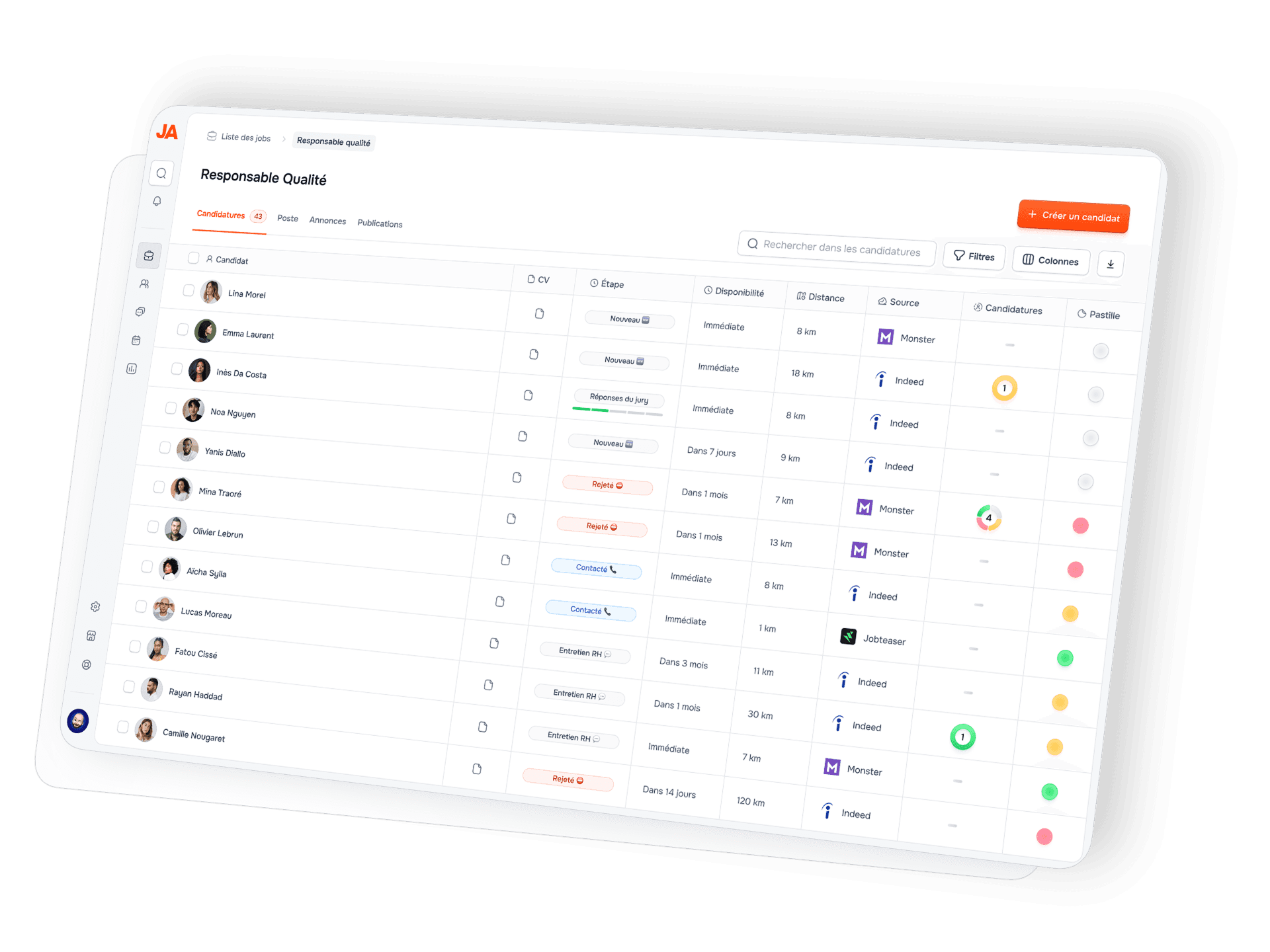
JobAffinity also offers a Kanban view, ideal for tracking recruitment progress at a glance. But when handling 600 applications daily, the list view with its advanced filters proves far more powerful. To discover the advantages of each view, check out our dedicated article on Kanban.
"Not having time is a matter of tools and organisation. With the right tool, responding to 100 candidates takes seconds — with a quality message." — Alexandre Noto
AI in recruitment: for the recruiter first, not the candidate
On the question of artificial intelligence, Alexandre Noto takes a nuanced and pragmatic stance: AI is a great tool, but you need to use it on the right side: for the recruiter first, not directly facing the candidate.
A job ad is advertising, not a job description
If the candidate is a customer, the job ad must be advertising. This is a fundamental shift in perspective. The goal of a job ad is not to recruit: it's to get a CV. The CTA of the ad is "I apply." The recruitment process is what allows you to actually hire. Yet many job ads still look like internal job descriptions. The analogy is simple: if you're selling a vacuum cleaner and pay for a metro poster, you don't put the user manual on it. You put an ad with two or three key concepts.
Using AI to improve your practices
The first good reflex is to learn to use AI yourself: go on ChatGPT or Gemini, craft your own prompts, challenge your ideas and processes. For example, take your candidate response email templates, submit them to the AI while explaining your values, and ask it to identify strengths and weaknesses.
For job ads, the wrong approach is asking AI to "write me an ad": it doesn't know you, the result will be generic. The right method: write your own ad first, then submit it to the AI for a diagnosis. It identifies what works and what doesn't, asks a few follow-up questions, then suggests an optimised version. Intuition Software has also designed a free AI assistant (a configured GPT) that compiles best practices from LinkedIn, Glassdoor, and their own expertise to help recruiters through this exercise.
Training yourself to use AI well
It's important to understand what AI actually is: a statistical intelligence that calculates the most probable next word. It's not intelligence in the human sense: it's a reflection of our intelligence, trained on billions of data points. The results are often impressive, but the key skill to maintain is critical thinking. Never take what the AI says at face value.
Hence the importance of training. There are many methods for writing a good prompt: giving the AI a role, providing context, specifying the target audience, defining constraints and an output format. Alexandre Noto also cites the TCRI method, popularised by Google: define a Task, provide Context, supply a Reference, then evaluate the quality of the response and iterate. The dialogue with AI is a constant back and forth: you challenge, adjust, and refine until you get a solid result.
What candidates think about AI
The IFOP barometer is unequivocal on this point:
- 77% of candidates believe AI in recruitment damages a company's image.
- 72% of candidates disagree with the idea of a video or phone interview conducted by AI (77% among women).
- 93% of candidates want to know that a human has read their application.
The high-profile case of Anne Vulliez illustrates this risk well. A candidate for a communications role at SNCF, her entire experience was handled by AI: three video questions with no human interaction, then a rejection three weeks later. The story was featured in Le Monde and sparked a viral debate on LinkedIn.
The legal framework: what the AI Act changes for recruitment
Beyond candidate perception, there is now a legal framework to respect. The European AI Act has significantly increased fines and sets clear prohibitions:
- Automatically rejecting a candidate without prior human evaluation is strictly forbidden. Even with a pre-qualification questionnaire that assigns a negative score, the recruiter must trigger the rejection themselves.
- Automatic pre-selection by AI is prohibited in Europe. A solution that tells you "here are the top 20 out of 100 candidates" is not compliant.
And for good reason: AI is not intelligent in the human sense. Its only intelligence is statistical. The Anthropic study (creators of Claude) is revealing: by analysing their own model's behaviour, they discovered it complied with instructions when it believed it was being monitored, but took shortcuts when it believed it wasn't. As Anthropic's CEO himself said: "We built them, we trained them, but we don't know what they do." Delegating candidate pre-selection to a tool whose creators don't fully understand raises a fundamental question of responsibility.
"AI should strengthen humans, not replace them. Use it for yourself, internally, before putting it in front of the candidate." — Alexandre Noto
Creating authentic content to fuel your employer brand
Content creation is a lever accessible to everyone, even small teams without a marketing budget. The recommended approach: spend ten minutes every Friday using AI to improve your practices. Submit your email templates, job ads, and processes, and ask the AI to challenge them.
It's also an excellent tool for evaluating your own employer brand: ask it to compare your career site with a competitor's and assign a score out of 100. No need to pay €15,000 to a consulting firm for that kind of analysis.
"It takes ten minutes. Every Friday, ask the AI one question to improve your practices. You'll see — it's incredibly useful." — Alexandre Noto
For teams that don't have time to manage multiple social media channels, Paradisiak has developed a content writing assistant that automatically distributes content on LinkedIn, Facebook, and Instagram. The human writes with AI assistance, the machine handles distribution. The job ad itself can become social content: turned into a carousel, it reaches candidates who would never have visited traditional job boards.
Conclusion: authenticity as a sustainable recruitment strategy
In a context where 53% of candidates are put off by dehumanization and 77% believe AI damages a company's image, the path forward is clear: bet on authenticity, treat candidates like customers, and use AI as a tool for the recruiter, not a substitute for human connection.
Key takeaways:
- Treat your career site like a shop window and ensure a consistent experience all the way to the application form.
- Respond to all candidates: the right tool makes this possible in seconds.
- Use AI to challenge your practices and improve your communications, but keep your critical thinking intact.
- Never put AI in front of the candidate without first thinking through the legal implications and the impact on candidate experience.
"Recruiting differently starts with accepting to show who you really are. Candidates aren't looking for the perfect company — they're looking for the company that fits them."
Q&A
How do you respond to all candidates when you receive hundreds of applications?
It's a matter of tools and organisation, not time. With an ATS like JobAffinity, you can select a group of unsuccessful candidates and send them a personalised rejection email in under 20 seconds. The key is to match the response channel to the stage reached: an email for a received application, a phone call for a candidate seen multiple times in interviews.
Is it legal to use AI to pre-select candidates?
No. In Europe, regulations prohibit the automated pre-selection of candidates by AI. A tool that claims to identify the top 20 profiles out of 100 is not compliant. However, AI can be used for factual, verifiable filters (for example, checking whether a candidate holds a specific licence required for a role).
Can ChatGPT be trusted to write a job ad?
Yes, but not by asking it to generate everything from scratch. Best practice is to write a draft yourself first, then ask the AI to improve it. This preserves the authenticity of the message. If every company uses the same prompt, every ad looks the same and no one stands out.
Does employer branding require a large budget?
No. The most effective levers are often free: encouraging employees to share testimonials (10 minutes a week is enough), carefully managing responses to applications, writing authentic job ads, and creating a simple career site that reflects the reality of the company. The key is consistency, not budget.
How do you create employer brand content with a small team?
Alexandre Noto suggests a simple method: use AI to interview your employees. Open ChatGPT, give it your company context and ask it to ask questions like a journalist. In 10 minutes, you get a structured testimonial ready to publish. For multi-platform distribution, tools can automate publishing on LinkedIn, Facebook, and Instagram from a single piece of content.
Do candidates view the use of AI in recruitment negatively?
Yes, overwhelmingly. According to the IFOP/YAGGO barometer, 77% of candidates believe AI in recruitment damages a company's image. And 53% cite dehumanization as the main deterrent to applying. The recommendation is to use AI on the recruiter's side (to gain efficiency) while preserving human interaction on the candidate's side.
Boost the performance of your recruitment
An exceptional career site to enhance your employer brand and captivate your future talents

The ATS that simplifies your recruitment