Recruitment: How to Optimize the Career Page to Facilitate Candidate Experience?



 11 min read
In a job market where talents are increasingly sought after, your career page is no longer a simple showcase of job offers. It represents the first significant contact between your future collaborators and your company. However, according to a CareerBuilder study, 60% of candidates abandon their application process due to poor user experience. This observation raises a crucial question: how to transform your career page into a real lever for attracting and converting talents?
Optimizing your career page relies on three fundamental pillars: an authentic and engaging employer brand, performant technological infrastructure, and fluid and intuitive candidate journey. In this complete guide, we reveal concrete strategies to create an irresistible candidate experience that will allow you to stand out and attract the best profiles.
Care for Your Employer Brand: The Foundation of an Impactful Career Page
1. Tell Your Story and Display Your Values
Your career page must be much more than a catalog of vacant positions. It must tell who you are as a company. Start by sharing your mission, vision, and the story that shaped your organization. Today's candidates, particularly generations Y and Z, seek meaning in their work. They want to understand the impact they'll have and the values they'll defend by joining you.
Be authentic and transparent in your communication. Present your company culture without filter: your work methods, your innovation approach, your societal or environmental commitment. This transparency creates an emotional connection with candidates and allows natural first filtering: you attract talents who truly share your convictions, thus reducing future turnover.
Don't hesitate to structure this section with strong visual elements: a timeline of your history, infographics on your values, or illustrations representing your company culture. Visual storytelling marks minds and makes your message memorable.
💡 According to a study conducted by CareeBuilder, 91% of candidates recognize that employer branding has an impact when they decide to apply (or not) to a company.
2. Modern Design and Immersive Visual Experience
Your career page's visual aspect directly reflects your professionalism and modernity. Invest in high-quality images and videos that capture the essence of your work environment. A virtual visit of your premises can make the difference, especially for geographically distant candidates or in the hybrid work context.
Your design must remain consistent with your global brand identity while being optimized for user experience. Adopt a modern UX/UI approach: aerated spaces, readable typography, intuitive navigation, and clear visual hierarchy. The objective is to naturally guide the visitor's gaze towards essential information and calls to action.
Also think about the emotion you want to evoke. Your color palette, typographic choices, and images must work together to create an atmosphere that reflects your culture. A dynamic tech startup won't have the same visual identity as a traditional consulting firm, and that's perfectly normal.
Technology Serving Candidate Experience and Performance

The crucial importance of a responsive career website
1. The Crucial Importance of a Responsive Career Website
More than 70% of job searches are performed on mobile today. If your career page isn't perfectly optimized for all screens, you potentially lose the majority of your potential candidates. A responsive website is no longer an option, it's an absolute necessity.
Adopt a "mobile first" approach: first design the mobile experience, then adapt it to larger screens. This guarantees that the essential is always accessible and navigation remains fluid even on a smartphone. Regularly test your page on different devices and browsers: a button too small, a form overflowing the screen, or loading time too long can be enough to make a qualified candidate flee.
Technical performance is also crucial. Optimize your image weight, minify your code, and ensure your page loads in less than three seconds. Each additional loading second significantly increases your abandonment rate.
👉 We actually offer companies to create a custom career website. Paradisiak is a web agency specialized in creating websites dedicated to Human Resources. Everything is designed to help you attract the best talents.
2. SEO Optimization: Making Your Career Page Visible
An exceptional career page is useless if no one finds it. Natural referencing of your recruitment website is therefore a major strategic issue. Start by identifying keywords your target candidates use: job names, specific skills, activity sectors, geographical locations.
Structure your content in an SEO-friendly way. Use a clear title hierarchy (H1, H2, H3) that naturally integrates your keywords. Each job offer must have its own optimized page with a descriptive title, attractive meta description, and rich content detailing the position, missions, sought skills, and offered advantages.
Internal linking is also essential. Create links between your job offers, job presentation pages, company life articles, and testimonials. This strategy not only improves your SEO, but also guides candidates towards information that interests them.
Don't forget the importance of fresh and regularly updated content. Regularly feed your career page with news, articles about your jobs, returns on your recruitment events. Google values active and relevant sites, and this content freshness significantly improves your visibility.
3. Transparent Integration with Your HR Tools
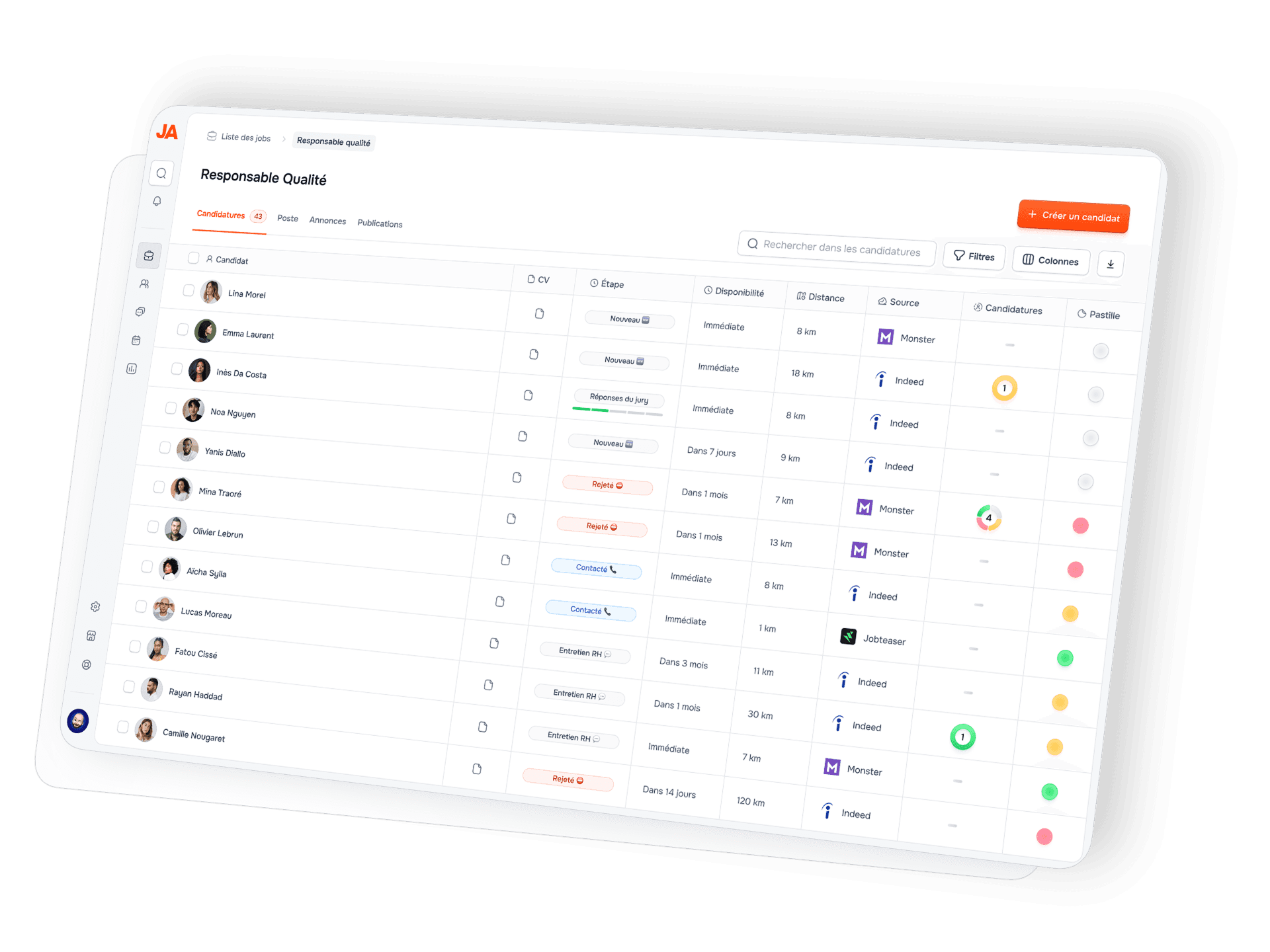
Your career page must not be an isolated island in your HR ecosystem. It must integrate perfectly with your candidate management system (ATS - Applicant Tracking System). This technical integration guarantees that each application is automatically recorded, tracked, and distributed to the right contacts without manual intervention.
The advantage for candidates is immediate: no break in their journey, instant confirmation of application receipt, and transparent tracking of their file's progress. For your HR teams, this means less data entry, fewer errors, and more time devoted to human interaction with candidates.
Facilitate Candidate Journey: From Visit to Application

A simple, fast and intuitive application process
1. A Simple, Fast and Intuitive Application Process
The application form is often the major friction point. Each additional field you request increases abandonment risk. Systematically ask yourself the question: is this information really necessary at this stage? In most cases, a CV, cover letter (optional), and contact details are enough for first selection.
Implement intelligent functionalities that facilitate candidates' lives. Automatic pre-filling of forms from uploaded CV considerably reduces application time. Importing information from LinkedIn or other professional platforms allows application in a few clicks. These technologies exist and are accessible, it would be a shame to deprive yourself of them.
Limit the number of steps in your application process. The ideal is a journey in three steps maximum: offer selection, form filling, confirmation. Clearly display progress with a visual indicator showing candidates where they are. This transparency reassures and encourages going to the end.
2. Clear and Omnipresent Calls to Action
Your call-to-action buttons (CTA) are your career page's conversion points. They must be immediately identifiable, understandable, and accessible. Use direct action verbs: "Apply now", "Send my spontaneous application", "Create job alert".
Strategic placement of your CTAs is crucial. Position one in the visible part of the page without scrolling, repeat it at the end of each important section, and ensure an application button is always accessible, even while scrolling. On mobile, consider a floating button that remains permanently visible.
Vary your CTAs according to the visitor's engagement level. For a candidate who hasn't yet found the ideal offer, propose "Send spontaneous application" or "Subscribe to job alerts". For one consulting a specific offer, the CTA "Apply to this offer" must be obvious and attractive. This diversification maximizes your conversion opportunities.
3. Transparency on the Recruitment Process
Uncertainty is the enemy of candidate experience. Many qualified talents give up applying or disengage during the process simply because they don't know what to expect. Fight this anxiety by clearly explaining your recruitment process from the career page.
Detail the steps following application: first response deadline, number of planned interviews, interview format (video, face-to-face, technical tests), final decision deadlines. This transparency demonstrates your professionalism and respect for candidates' time.
Don't hesitate to create a FAQ section dedicated to the recruitment process. Answer recurring questions: "How long does your recruitment process take?", "Do you give feedback to non-selected candidates?", "How to prepare the interview?". This anticipation of questions significantly improves experience and reduces your HR teams' solicitations.
4. Managing Spontaneous Applications and Job Alerts
All talents visiting your career page won't immediately find the offer that corresponds to them. This is an opportunity, not a loss. Set up a spontaneous application collection system that allows you to build a talent pool for your future recruitments.
Facilitate sending spontaneous applications with a dedicated form, simple and accessible from all your career website pages. Allow candidates to specify their areas of interest, availability, and type of position sought. This information will allow you to contact them quickly when a corresponding opportunity arises.
The job alert system is another powerful tool to maintain candidate engagement. Offer them to subscribe to personalized notifications based on precise criteria: position type, location, experience level. Each new corresponding offer will be automatically sent to them, thus keeping your company on their radar.
Be careful however about GDPR compliance. Ensure obtaining explicit candidate consent for collecting and storing their personal data. Clearly inform them of the use that will be made of their information, their retention duration, and their rights (access, modification, deletion). This compliance is not only a legal obligation, it also reinforces trust.
Measure and Improve: Continuous Optimization
1. Key Performance Indicators of Your Career Page
What isn't measured can't be improved. Identify and regularly track essential KPIs of your career page. The visitor-application conversion rate is the king indicator: it tells you the percentage of visitors who take the step of applying. A low rate signals problems in your journey or value proposition.
Time spent on the page is also revealing. Very short time may indicate visitors don't find what they're looking for or your content doesn't engage them. Conversely, excessive time on the application form may signal difficulties in the process.
Analyze your traffic sources to understand where your best candidates come from: social networks, organic search, ads, job boards. This knowledge allows you to optimize your acquisition investments. Bounce rate by source also helps you identify channels attracting the least qualified visitors.
Don't forget to track the number of spontaneous applications and alert subscriptions. These metrics measure your ability to build a talent pool for the future. A high rate indicates your employer brand is attractive enough to generate interest even without immediate offers.
2. Collect Candidate Feedback
Your candidates are the best source of information about your candidate experience quality. Set up post-application satisfaction surveys, short and targeted. Ask them to evaluate the process ease, information clarity, received communication quality.
Don't be afraid of negative feedback. They're often the richest in lessons. A candidate who reports having abandoned their application because the form didn't work on mobile gives you precious information that can benefit hundreds of future candidates.
Also encourage public reviews on platforms like Glassdoor. These authentic testimonials, whether positive or constructive, reinforce your credibility and show you're listening. Systematically respond to reviews, especially negative ones, with professionalism and by proposing concrete solutions.
Conclusion: Investing in Candidate Experience, Investing in Your Future
Optimizing your career page is not a one-time project but a continuous approach combining authentic employer brand, technological excellence, fluid user experience, and constant performance measurement. In a context where talents are companies' most strategic resource, neglecting your career page amounts to letting your competitors capture the best profiles.
Each element we explored in this guide contributes to a unique objective: making your career page a talent magnet that attracts, engages, and converts candidates who will share your vision and contribute to your growth. Companies investing in candidate experience see not only an increase in number and quality of applications, but also an improvement in their brand image and reduction in recruitment costs.
Ready to transform your career page into a real HR performance lever? Paradisiak experts support you in auditing, designing, and optimizing your recruitment website. We create custom candidate experiences that reflect your DNA and maximize your conversions.
Boost the performance of your recruitment
An exceptional career site to enhance your employer brand and captivate your future talents

The ATS that simplifies your recruitment