ATS Integration with Career Sites: How to Optimize Recruitment in 2026?



 9 min read
Integrating an ATS (Applicant Tracking System) with a career site means connecting a company's career page to a candidate management software. Concretely, when a candidate applies through the site, their application automatically arrives in the ATS without any manual data entry. Conversely, every job posting created in the ATS is instantly displayed on the career site. In a context where 80% of companies use applicant tracking tools (ATS) to manage their recruitment processes, integration with the career site is essential for effective talent acquisition.
This integration may seem technical and complex, but if you want to benefit from this automation, Paradisiak explains which method to implement. Setup, benefits, steps — discover how to successfully integrate an ATS with your career site and transform your recruitment.
ATS Integration with a Career Site: Summary
- ATS integration with a career site automatically synchronizes both systems: job postings published in the ATS appear in real time on the career site, and every application received via the career site is automatically recorded in the ATS with all relevant candidate information.
- The functionalities enabled by this integration include the automatic reception of all applications in a single database, automatic email notifications to candidates at each stage, job posting to multiple job boards, and tracking of recruitment performance.
- There are four main integration methods: ATS-hosted pages, iFrame, CMS plugins, and custom API integration.

What Is ATS Integration with a Career Site?
Integrating an ATS with a career site means automatically connecting the career page (the public-facing showcase visible to candidates) with the candidate management software, the ATS. This connection enables real-time data exchange without manual intervention from recruiters.
Concretely, when a recruiter creates, modifies, or closes a job posting in the ATS, this information is immediately synchronized to the career site. Conversely, when a candidate submits an application through the site, their information and CV are automatically transmitted to the ATS, creating a complete candidate profile ready to be processed by the HR teams.

How Does ATS Integration with a Career Site Work?
The technical integration of an ATS with a career site relies on automated data exchange between the two systems. This two-way synchronization between the ATS and the career site is made possible by two complementary technologies:
- APIs (Application Programming Interfaces): an API is the common language that allows the career site to communicate with the ATS. It enables structured queries, such as "give me the up-to-date list of all job postings" or "record this new application with these details." Data is exchanged in a structured format, typically JSON, to ensure its integrity.
- Webhooks: webhooks act as a proactive notification system, meaning the ATS automatically alerts the career site whenever an event occurs, for example "the Senior Developer position has just been closed." This approach guarantees real-time updates without overloading the systems.
What Are the Key Functionalities Enabled by Integration?
Integrating an ATS with a career site unlocks a set of advanced features that fundamentally transform recruitment processes:
- Automatic centralization of applications: all applications received through the career site are automatically recorded in the ATS, eliminating manual data entry and reducing the risks of errors or data loss.
- Automated communication with candidates: confirmation emails, status updates, or follow-up messages are sent automatically at each stage of the process, improving the candidate experience without additional effort from recruiters.
- Multi-posting of job listings: a posting published in the ATS can be automatically distributed across multiple job boards (Indeed, LinkedIn, Welcome to the Jungle, etc.), maximizing recruitment visibility.
- Recruitment performance tracking: dashboards and analytical reports allow measuring the effectiveness of candidate sources, average time-to-hire, conversion rates at each stage of the recruitment funnel, and more.
- Collaborative management of applications: multiple members of the HR team can simultaneously access applications, leave comments, assign ratings, and make coordinated decisions.
What Are the Different Technical Integration Methods?
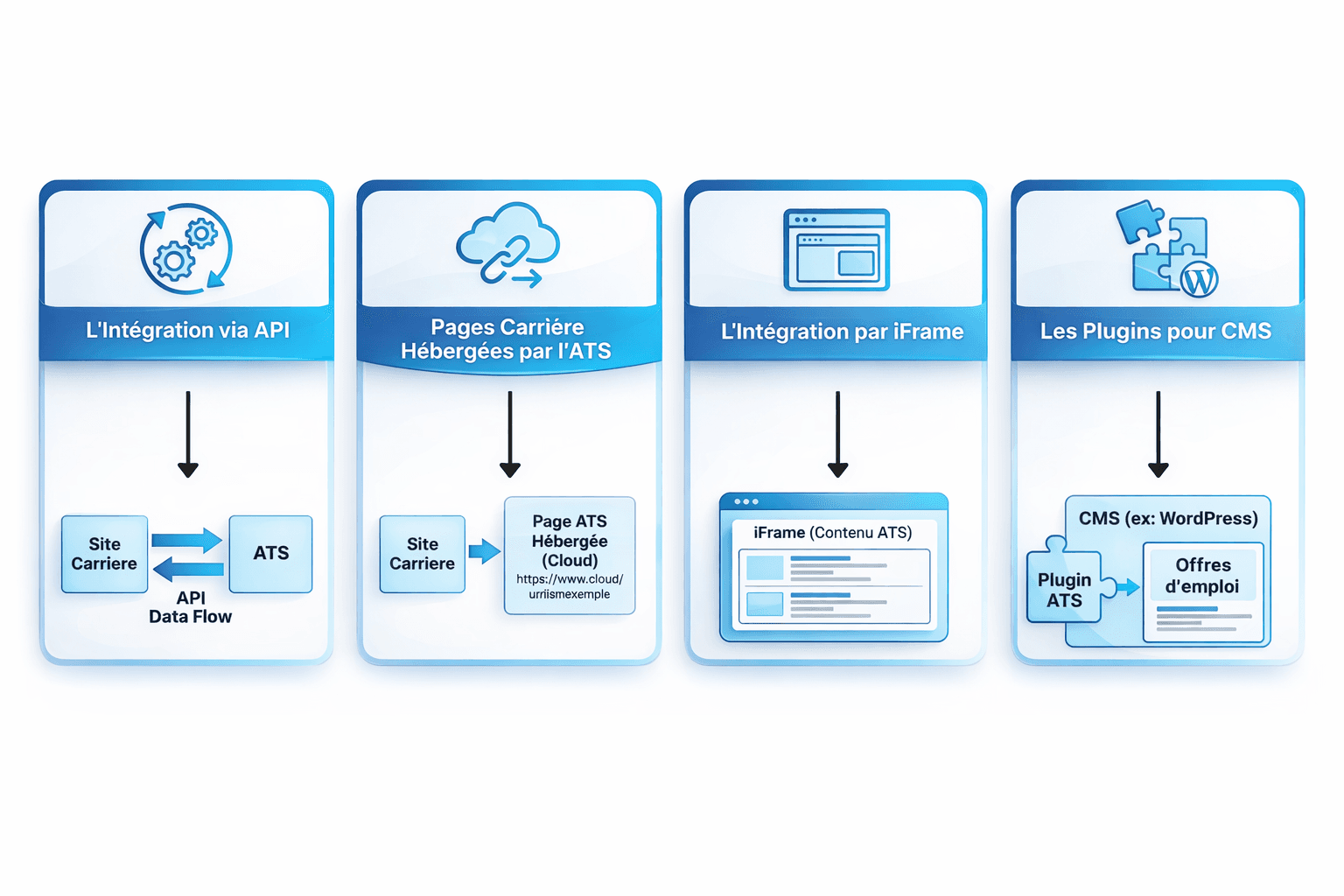
There are four main methods for integrating an ATS with a career site, each with its own advantages and constraints:
ATS-Hosted Pages
The simplest method involves using career pages directly hosted by the ATS vendor. The company simply redirects candidates to a subdomain managed by the ATS (for example careers.company.com). This approach is quick to implement, typically included in the subscription, and requires minimal technical resources. In return, graphical customization options are limited.
iFrame
The iFrame integration embeds an HTML frame directly in a page of the existing career site to display content from the ATS. Job listings and application forms appear within this frame, giving the impression of a unified experience. This method is relatively simple to set up but can cause issues with user experience (scrolling, responsive design) and search engine optimization (SEO).
CMS Plugins
For career sites built on popular CMS platforms like WordPress, dedicated plugins are available to facilitate integration with specific ATS systems. These plugins automatically manage the synchronization of job postings and applications, with configuration accessible to non-technical teams. The cost ranges from free to a few hundred euros depending on the vendor and features.
Custom API Integration
API integration is the most advanced and flexible method. Developers use the ATS's API to create a fully customized connection between the career site and the ATS. This approach allows total customization of the candidate experience, seamless integration with the site's design, and advanced features. In return, it requires significant development resources and a more substantial investment.

What Are the Benefits of Integrating an ATS with the Career Site for HR Teams?
Integrating an ATS with the career site provides recruitment teams with:
- Massive time savings on administrative tasks: automation frees recruiters from repetitive and time-consuming tasks such as CV screening, sending follow-up emails, or manually updating job listings.
- A modern and professional candidate experience: a smooth, fast, and transparent application process strengthens candidate satisfaction and employer branding. However, it is essential to preserve the relational and human dimension of recruitment, as too many filters or automated messages can create a cold experience.
- Streamlined internal collaboration: decisions are made faster because all information is accessible in one place, and the risk of missing a strong profile is reduced. To ensure smooth internal operations, it is essential to organize training sessions and support teams in adopting the ATS.
- Better recruitment quality with reduced costs: by combining broader sourcing through multi-posting, more objective evaluation through collaborative recruitment tools and evaluation grids, and greater responsiveness in the process, companies significantly reduce their time-to-hire.
How to Preserve Employer Branding Between ATS and Career Site?
Preserving employer branding during ATS-career site integration relies on:
- Visual identity consistency between the site and the ATS: the design of the career section (colors, fonts, logos, layout) should be consistent with the rest of the company's website. This visual continuity reassures candidates and reinforces the company's professionalism.
- Mobile optimization of the application process: more than 50% of candidates search and apply for jobs from their smartphones. The application process must therefore be simple, fast, and fully functional on mobile. A "mobile-first" approach should be considered during the design of the integration.
What Are the Legal Requirements to Comply With (GDPR)?
ATS-career site integration must comply with three fundamental GDPR obligations to avoid administrative penalties, which can be very severe:
- Collecting explicit and informed consent from candidates
- Guaranteeing their rights of access, rectification, erasure, and data portability
- Applying limited data retention periods.
Explicit and Informed Consent
Explicit consent from the candidate must be obtained for the collection and processing of their personal data. This is typically done via a checkbox in the application form, accompanied by a link to the company's privacy policy.
The candidate must clearly understand how their data will be used and for how long it will be retained.
Guaranteeing Candidates' Rights
The GDPR grants candidates several fundamental rights that the recruitment software must be able to ensure:
- The right of access: the candidate may request to view all the data held about them.
- The right of rectification: the candidate may request the correction of inaccurate or incomplete information.
- The right to erasure: the candidate may request the deletion of their data, particularly if they withdraw their consent.
- The right to data portability: the candidate may request to retrieve their data in a structured and readable format for transfer elsewhere.
Limited Retention Periods
The CNIL (Commission Nationale de l'Informatique et des Libertés) recommends a maximum retention period of 2 years for data from unsuccessful applications. The ATS must allow for automated management of these periods with automatic deletion of data after the deadline, or renewal of consent requests to candidates to extend the retention of their information in the talent pool.
Integrating an ATS with the career site transforms recruitment by automating time-consuming tasks, centralizing applications, and offering a modern candidate experience that strengthens employer branding.
Paradisiak supports companies through this transformation by offering a solution designed to simplify career site integration. Contact us today to discover how Paradisiak can transform your recruitment and maximize the performance of your career site.
FAQ
How Much Does ATS Integration with a Career Site Cost?
ATS-hosted pages are generally included in the ATS subscription (between €100 and €500 per month depending on recruitment volume) with annual maintenance. CMS plugins cost between €0 and €500 depending on the vendor. Custom API integration requires a development investment between €5,000 and €30,000, also with annual maintenance to plan for.
How Long Does ATS Integration Take?
A custom API integration typically takes between 4 and 12 weeks depending on the complexity of the project, including the development phase, testing, and team training.
Can an ATS Be Integrated with Any Website?
Yes, in the vast majority of cases, as modern ATS platforms offer several integration methods that adapt to different website technologies. Technical constraints depend mainly on the chosen method and available development resources.
What Happens When Changing ATS?
Changing ATS requires a new technical integration. It is recommended to favor ATS platforms that comply with API standards and facilitate data export to minimize difficulties in case of a change. Most modern ATS platforms allow exporting the candidate database to ensure continuity.
Boost the performance of your recruitment
An exceptional career site to enhance your employer brand and captivate your future talents
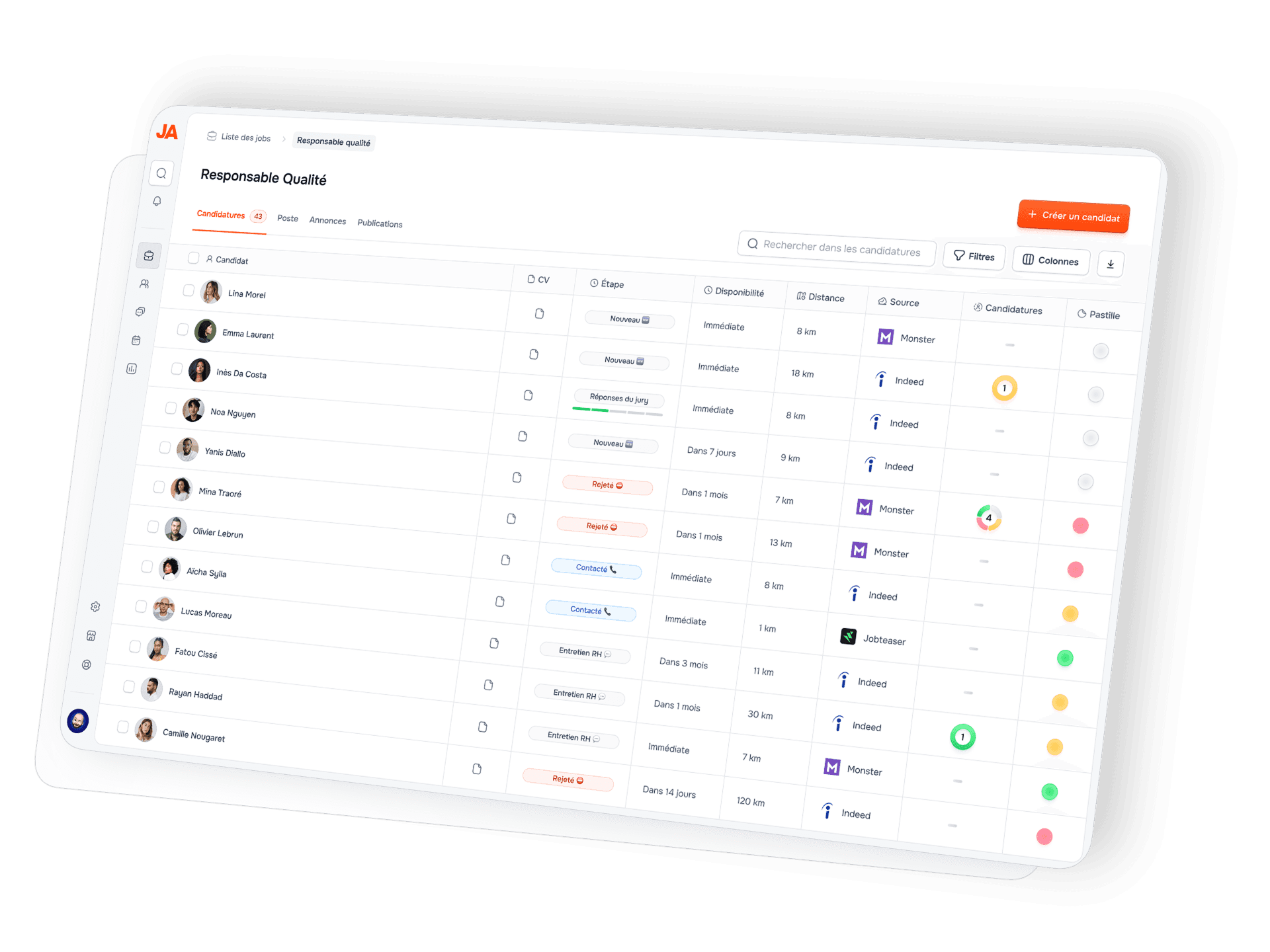

The ATS that simplifies your recruitment