Recruitment ghosting in 2026: three studies, same verdict


 5 min read
80% of your candidates are ghosted. Your career site will not fix that.
80% of French candidates receive no response after an interview. The figure comes from the Jooble 2026 survey of 1,337 working adults. And 58.9% of them say it happens regularly. Not once. More than three times.
Meanwhile, employer branding budgets keep climbing. Employee videos, culture pages, career sites redesigned from scratch. The storefront gets a fresh coat of paint. But behind it, the recruitment process sends an entirely different message: silence.
It is like renovating a restaurant's facade and then leaving customers waiting two hours without anyone coming to take their order. The decor does not compensate for the experience.
Recruitment ghosting in 2026: three studies, same verdict
The data converges, regardless of the source.
The Jooble survey places the ghosting rate at 80%. The Yaggo/IFOP barometer, conducted among 2,004 respondents in January 2026, puts it at 64%, with a peak of 72% among 25-34 year-olds. The ALLinOne study, covering 4,872 candidates, reports 73% of applications receiving no response whatsoever.
Three different methodologies, three distinct samples, and a floor that never drops below 64%.
Ghosting is not an incident. It is a market standard. And 80.7% of this silence occurs at the resume submission stage, before any exchange has taken place. In other words, the majority of candidates are ignored before they even exist in the recruiter's eyes.
The asymmetry that says it all
Here is the figure that should appear in every employer branding brief: 91.8% of candidates notify the employer if they cannot attend an interview (Jooble 2026). Nine out of ten candidates extend the courtesy that companies do not return.
This asymmetry tells you everything about the state of the relationship. Candidates play by rules that recruitment does not apply to itself. They are asked for transparency, responsiveness, and professionalism. In return, they face a wall of silence.
Any HR director who sees this figure should ask a simple question: if our employees treated our clients the way we treat our candidates, how long would our reputation last?
What silence really costs your employer brand
The Yaggo/IFOP barometer puts numbers on the damage. 60% of ghosted candidates have a diminished perception of the company. 58% will never apply again.
Let us do the math. A company that receives 500 applications per year and ghosts 300 of them (the common ratio) potentially creates 180 people with a degraded image of its brand. And 174 candidates lost for good. Every year. Not counting word of mouth: a disappointed candidate talks about it. On Glassdoor. On LinkedIn. To former colleagues who might have been strong hires themselves.
No employer branding budget can absorb that rate of destruction. It is a leaky bucket: you pour content in from the top while silence drains the reservoir from the bottom.
On Monday, we analyzed right here how AI in recruitment can betray employer brand promises. Ghosting is the human version of the same problem: a promise of attention that turns into indifference.
86.4% want legislation. That is not trivial.
When 86.4% of candidates demand a law making post-interview feedback mandatory, this is no longer a niche opinion. It is a verdict on the profession's inability to self-regulate.
We are not there yet legally. But the signal is clear: candidates no longer believe companies will change on their own. They want external constraint because voluntary commitment has produced nothing.
For companies investing in employer branding, this is a warning. The recruitment market is moving toward a world where silence will be a measurable reputational risk. Those who anticipate will be those who recruit.
The problem is not the content. It is the process.
A well-built career site remains an asset. No one is saying otherwise. But it only works if the candidate experience behind it is consistent with what it promises.
43% of candidates have never received an acknowledgement of receipt (IFOP 2026). The candidate who lands on your careers page, reads your values, watches your employee testimonials, then applies and receives nothing, not even an automated email, what do they remember? Not your values. The silence.
This is a topic we explored during our webinar on candidate experience: the consistency between what employer branding promises and what the candidate actually experiences plays out in the details of the process, not in grand statements.
The good news: fixing this does not require additional budget. These are process adjustments.
An automatic acknowledgement for every application. A follow-up email when the position is filled. A polite "no" rather than nothing. 74% of candidates prefer an automated rejection over silence (ALLinOne 2026). The bar is not excellence: it is the existence of a response, any response at all.
Run the test yourself
Here is an exercise that takes 15 minutes and is worth more than any employer branding audit.
Go to your own career site. Apply to an open position using a personal email address. Then wait. Count the days. Note every interaction, or the absence of interaction.
Compare what you experience with what your "Our commitments" page promises. The gap you discover is what your candidates go through with every application. And while you are at it, run your job postings through our free job ad audit tool: if the first point of contact with the candidate is not up to standard, the rest of the process is already starting at a disadvantage.
82% of them expect a response within two weeks (IFOP 2026). If your process does not include anything within that window, your employer brand is speaking into the void.
The career site opens the door. Silence slams it shut. And no content, however creative, will reopen a door slammed in a candidate's face.
Boost the performance of your recruitment
An exceptional career site to enhance your employer brand and captivate your future talents
Frequently asked questions
What is ghosting in recruitment?
Recruitment ghosting refers to a company's complete silence after an application or interview. According to the Jooble 2026 survey, <strong>80% of candidates</strong> experience it, and 58.9% say it happens regularly (more than 3 times).
How does ghosting affect employer branding?
Ghosting directly damages employer branding: <strong>60% of candidates</strong> have a diminished perception of the company after being ghosted, and <strong>58% will never apply again</strong> (Yaggo/IFOP barometer 2026). Every ghosted candidate becomes a potential detractor.
How can companies avoid ghosting candidates?
Three concrete actions: <strong>an automatic acknowledgement</strong> for every application, <strong>a visible status tracker</strong> for the candidate, and <strong>a systematic response</strong> even when negative. 74% of candidates prefer an automated rejection over total silence.
Do candidates want legislation against ghosting?
Yes, <strong>86.4% of candidates</strong> want a law making post-interview feedback mandatory (Jooble 2026). This figure reflects a loss of trust in companies' ability to self-regulate on candidate communication.
How long do candidates wait for a response?
<strong>82% of candidates</strong> expect a response within two weeks (IFOP 2026). Beyond that deadline with no reply, the silence is interpreted as a rejection, and the company's image suffers lasting damage.
Does ghosting affect certain age groups more than others?
Yes, 25-34 year-olds are the most affected with a ghosting rate of <strong>72%</strong> according to the Yaggo/IFOP 2026 barometer, compared to a 64% average. This age group is also the most active on social media, amplifying the negative reputational impact.
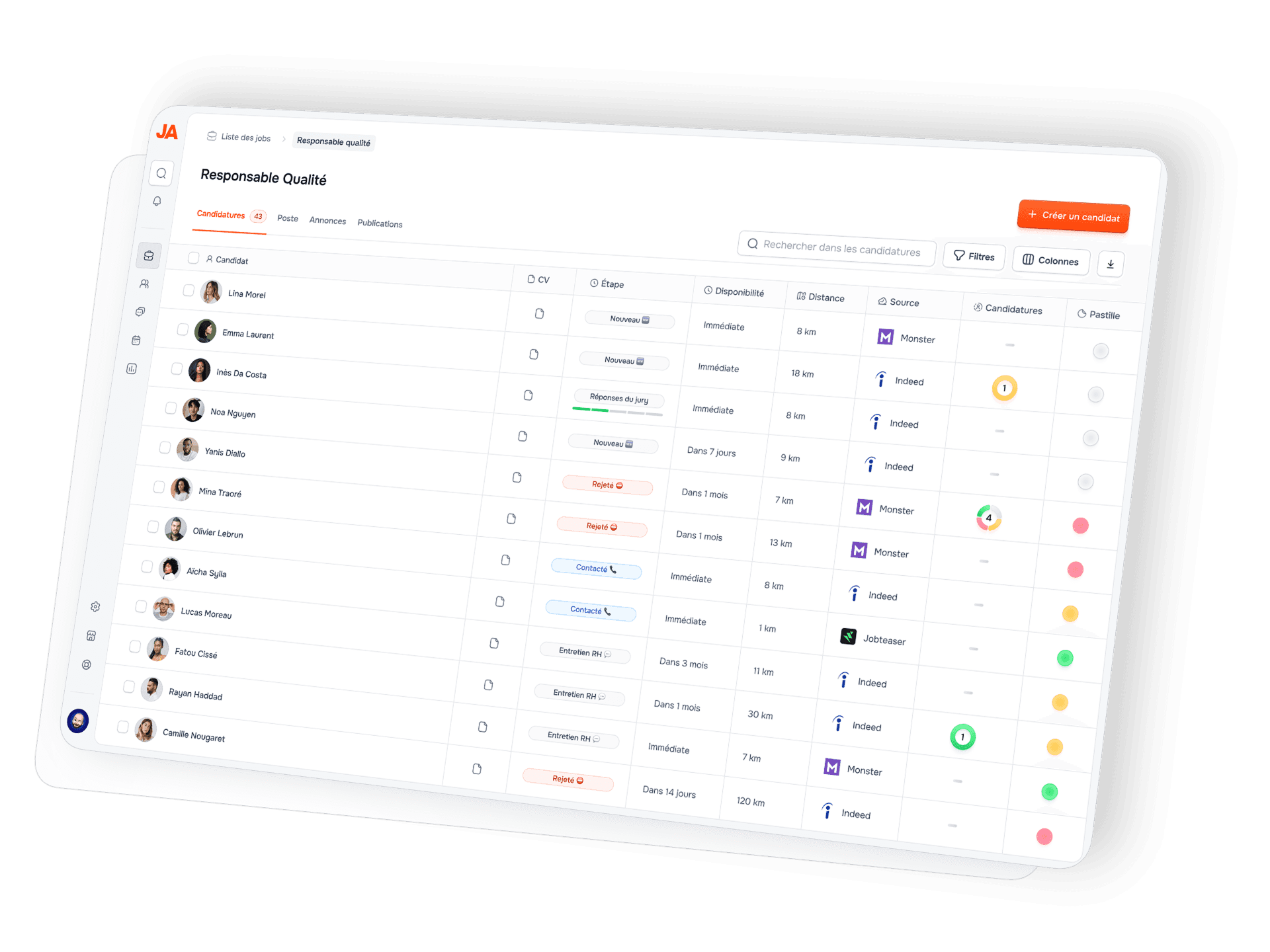

The ATS that simplifies your recruitment